Chapters
Just Another Tuesday
A Tuesday, 2010. I was in the car when it happened. A truck pulled up behind me at a light. Wrong color. Wrong model. The grille sparked the fear.
My chest clamped. My hands went cold. I sat through a green light because I could not move my foot.
What the fuck is wrong with me?
I had done the work. Therapy. Group. The long reckoning. I had named what happened. I had traced the patterns. I had built language for the thing that took my twenties and more. And still my body saw a truck and froze: he is following me again.
Seventeen years my body had kept a vigilant hum deep in my chest. Seventeen years of being ready. It did not know the danger was gone. I had told it. But no amount of understanding in my head was going to reach down and shut it off.
What I wish someone had told me then: your body is doing exactly what it was trained to do. For seventeen years, the training was vigilance. The body keeps what it was given. And the work of teaching it something else is a whole different kind of work than the work your mind already finished.
This piece is for the woman sitting where I sat. Still sore. Still integrating. Quietly furious that no one told her this part would feel so heavy.
The Tired No One Warns You About
There is a particular kind of tired that comes after. Not the tired of crisis. Not the white-knuckled exhaustion of surviving the thing. The tired of a body that did not get the memo that the emergency is over.
You are in the aftermath.
The aftermath is the long, un-cinematic middle. The sessions are working. Your body is still doing what it knows how to do. Nobody has a good story for what to do with the gap between those two facts.
Welcome, Seeker. You are not losing your mind. You are carrying the weight of a body that learned to keep you alive and is slow to learn it is allowed to stop.
The Mind Finishes First. The Body Takes Its Time.
The mind is fast. The mind moves at the speed of language. The mind can reach a conclusion, name a wound, file it into a category, and build a new story around what happened, all before lunch.
The body is slow.
The body stores what happened in muscle, in breath pattern, in the small way you hold your shoulders when you walk through a parking lot. The body does not release its keeping because you finally put words to the thing. The body releases when the body is ready. On its own schedule. With its own pace. And nobody consults you about the timeline.
This is where somatic exhaustion actually lives. You have done the cognitive work. You can trace the origin of your responses. You can explain yourself to yourself.
And still the chest hums. Still the jaw is clenched when you wake up. Still you flinch at a particular tone of voice, and then you spend the next twenty minutes furious with yourself for flinching, because you thought you were past this, because the books and the sessions and the long work practically promised you would be past this by now.
What you are doing is integration. From the inside, integration and failure can feel identical. The difference is direction. Failure stays stuck. Integration moves, even when you cannot see the movement.
Clinical Names Do Not Reach It
The clinical name for what your body is experiencing is called somatic exhaustion.
The clinical name does not help much when you are sitting in your car at a green light and cannot move your foot. The body does not speak medical. The body speaks pressure, weight, temperature, motion. If the tools you bring to the aftermath are all language tools, you will exhaust yourself reaching for a door that does not open from that side of the wall.
Therapy works on the mind first. That is its nature. A room or a screen or a group, a trained witness, language. It works from the neck up. It can carry you a long way. It was never built to reach the place in your chest that learned, in 2013 or 1991 or whenever your body learned it, to be ready.
The place in your chest needs a different kind of tool.
Art as a Tool the Body Can Hear
Art is a body tool.
Making a mark on paper is a physical act. Shoulder. Arm. Hand. The pressure of your weight onto a surface that pushes back. When the mind has done what it can do and the body is still carrying what it carries, mark-making gives the body somewhere to set something down.
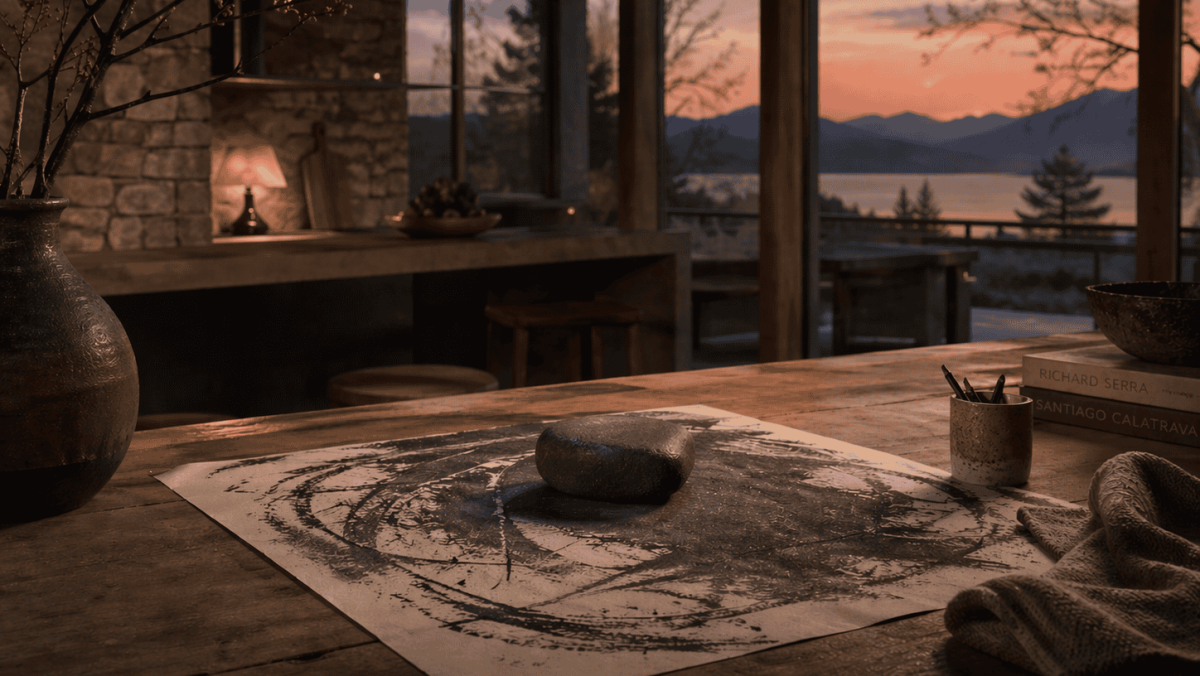
I do a ritual on my kitchen table when the hum in my chest gets loud enough to drown out sleep. It is not art therapy. Nothing beautiful happens. What happens is transfer. Force moves out of my body, through my hand, into the paper. The stone holds the paper. The container closes.
That is the whole thing.
The Weight of What Remains

This ritual takes no artistic skill. Read that again. None.
What it takes is a piece of heavy paper, a stick of charcoal, and a stone with enough weight to hold a page down. No cure here. No breakthrough. A container. A temporary one. Somewhere to set the weight for an evening so the body can rest.
What you need: one piece of heavy paper or cardstock. The cardboard box waiting to get recycled will work. A stick of charcoal, or a dark pencil if charcoal is not at hand. One stone with real weight (see the compositional elements below). A flat surface. Enough privacy that you cannot perform this for anyone.
Step One: Find where the weight lives.
Before you touch the paper, sit with the exhaustion for a breath. Locate it in the body. Shoulders. Sternum. Jaw. Gut. The back of the throat.
Locate where the weight lives in your body. This is an act of physical orientation. The body is asking you to listen before you act.
Step Two: Let the charcoal carry it.
Pick up the charcoal. Press it against the paper with the weight that matches what you are carrying. Press. Drag. Let the paper take the force.
Fill the paper if you need to. Use both hands if the body asks for both. Make heavy marks that match the exact weight you are carrying. Let the charcoal draw the exhaustion straight out of the tissue where it lives.
One thing is happening here and it is physical. The body is transferring pressure out of itself, through the hand, through the charcoal, into the paper. Transfer. That is the whole point.
Step Three: Place the anchor.
When the mark-making is complete, set the charcoal down. Take the stone in both hands. Feel its weight. Its density. Its stillness.
Place it directly on the paper.
The paper holds the marks. The stone holds the paper. You have built a container. For an evening. For a day. For a weekend. Not longer. A container that closes forever becomes a cage.
If the weight returns before you are ready to lift the stone, make another aftermath paper. Slide it beneath the anchor. Add it to what the anchor holds.
After the Marks
The ritual is one tool among several for the long middle. Here are others.
Pressure and weight. The body responds to physical containment. A weighted blanket. A stone in the palm. Both feet pressed firmly on the floor. These do not cure the hum. They are physical signals. The ground is here. The boundary is here. You are held.
Repetition without outcome. Repetitive physical motion with no product and no standard of success is one of the quietest ways to let the body downshift. Knitting. Folding laundry. Walking the same block at the same pace. The body finds its rhythm.
Named rest. There is a difference between collapsing from exhaustion and choosing to rest. The choice matters. When you say out loud, my body is working hard and it has earned a pause, you give that work a witness. The witness is the thing that changes you.
The anchor as witness. A stone on a paper is a small thing. It is also a real thing. It has weight. When the exhaustion of the long middle feels invisible, the anchor makes it real. Someone set something down. Someone made a mark. Someone said: this weight exists, and I am placing it here for now.

The messy, unresolved parts of who you are, the parts that do not fit the wellness story, the soreness your Shadow carries, the Animus patiently awaiting the negotiation, the Creator’s ugly marks on heavy paper, all of it belongs here. None of it has to be hidden from yourself for you to be making progress.
A Companion for the Long Middle
If you are looking for a physical anchor with more presence than a stone alone, my SoulStitch™ dolls were built for exactly this threshold.
She holds the room. Inside her are three stones, each chosen for what it carries in this kind of work. Clear Quartz amplifies focus and sharpens clarity, taking whatever you bring to the session and giving it more signal. Rose Quartz carries self-acceptance and the slow work of emotional release: present before you are finished, and steady after. Amethyst is a stone of serious inner work and spiritual protection, built to hold emotional complexity from a place of unshakable peace.
She is a companion for the middle. She sits where you sit. She does not need anything from you. Come find her when you are ready.
The Close
The progress is learning how to set the weight down. That is the whole thing.
My body still hums sometimes. The hum is quieter now. I know what it is when it shows up. I know what to do with it. I have paper, and charcoal, and a stone that has held me on more nights than I can count.
You will build your own. You will find the paper. You will find the stone. You will find that your hand knows how to press the charcoal just right.
The body that carried you this far will carry you the rest of the way. It just needs somewhere to set the weight down, only for a while.
Compositional Elements for This Ritual
Each element in the artifact below is chosen for what it carries and absorbs: what it holds when you need both hands free, what it clears when the room has too much history in it, what it names before the brain turns it into something pretty. Everything here is a working tool.
The document includes eight elements across four categories: three archetypes, three colors, two herbs, and two semi-precious stones. Each entry names the element, describes what it holds in this ritual specifically, and offers one way to work with it outside of this.
Download A Somatic Ritual: The Weight of What Remains with Compositional Elements