Chapters
You already know the language.
You know what the vagus nerve does when a client crosses your threshold. You know what bracing looks like in a jaw, a shoulder, a held breath. You know the difference between a freeze that needs warmth and a freeze that needs space.

And still.
There are sessions when the room feels like it cannot hold what just walked in.
The talk is doing its job. The client is doing their job. You are doing your job. Under all of it, a quieter question keeps rising in your own body:
Where is this weight supposed to go?
This piece is about that question.
About the hands. About the shelf. About the objects that sit quietly in the room until the body needs them. About what human beings across wildly different traditions understood long before any of us had the word somatic.
The body can only carry so much before it starts outsourcing.
A stone. A bead. A bowl. A bundle. A bell. A small thing with a job.
Something outside the body agrees to hold part of the load, and the nervous system finally gets a little room to breathe.
The Psychological Necessity of Grounding Objects for Therapy Room Spaces
Trauma is, among other brutal things, a storage problem.
The material the nervous system cannot metabolize has to live somewhere. Without an external container, it rents space in the tissue. The shoulder that will not drop. The jaw that has not unclenched in a decade. The gut that braces every time the phone rings. You have seen this in clients. You have felt it in yourself after a heavy week.
Practitioner burnout often hides in that residue. Some weight does not leave the room just because the appointment ended. The body keeps score, and it keeps leftovers.
Grounding objects for therapy room spaces answer that storage problem with something real enough to touch.
Props sit there. Ambiance flatters the room. A true grounding object works. It gives the unbearable a temporary address outside the body while the nervous system catches up.
A stone in the palm gives the hand a job besides bracing. A weighted object on the lap gives proprioception something stable to track. A bowl on a shelf gives a thought somewhere to land.
None of this has to be dressed up in mystery.
It is the same logic that makes a client reach for the corner of a blanket when the memory comes close. The hand needs something. The body needs something. The nervous system, in the middle of regulation work, needs rhythm, pressure, texture, and weight it does not have to generate alone.
Used responsibly, grounding objects become nervous system regulation tools: material supports that give survival energy somewhere safe to land.
That is the function underneath every tradition we are about to touch.
Containment. Anchoring. Externalization. Rhythm. Witnessing.
The forms differ wildly. The need does not.
Somatic Tools for Therapists: Beyond Aesthetic Decor
A beautiful room can be useless.
Lists can name tools without telling you how those tools behave in a room.
A piece of driftwood styled into a vignette is decor. The same piece of driftwood, chosen because its weight in your hand resets your breathing before a hard session, crosses the line into tool.
The wood did not change. The relationship did.
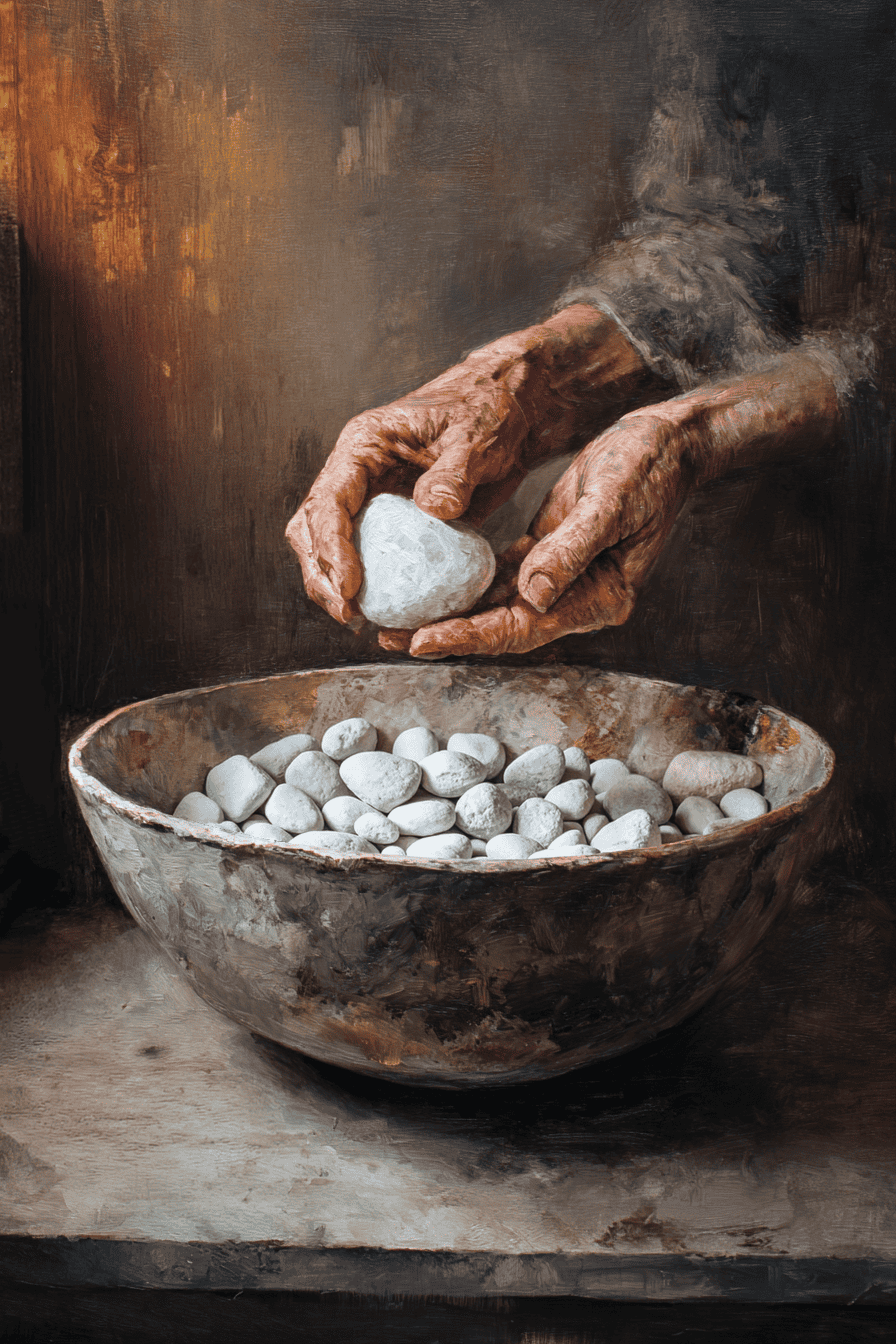
Somatic tools for therapists earn their place by function. They are in the room to redistribute load. The plant in the corner gives the eye somewhere to rest when the conversation gets sharp. The bowl on the table offers a place for the stone a client has been gripping for forty-five minutes. That small act of setting down can become its own piece of work.
Color can work too, when it has a job. Green gives the eye a living place to rest, a healthy signal that something in the room is still growing. Blue lowers the temperature of the space. It gives the nervous system a peaceful horizon instead of another demand.
Functional art belongs in the same conversation as active healing practice. The trauma-informed art for therapy office question is the same question:
Does this image have a job?
Does it witness something? Hold something? Give the body an archetype to recognize before the mouth can name it? Or is it hanging there because the wall is lonely?
A practitioner I know keeps a single piece of petrified wood on the table between her chair and the client chair. It is heavy. It is something the earth refused to forget. It does not match the rest of the room.
When sessions move into territory where language starts limping, clients reach for it without being told. They hold it. They put it down. They pick it up again. She does not explain it because it does not need explaining.
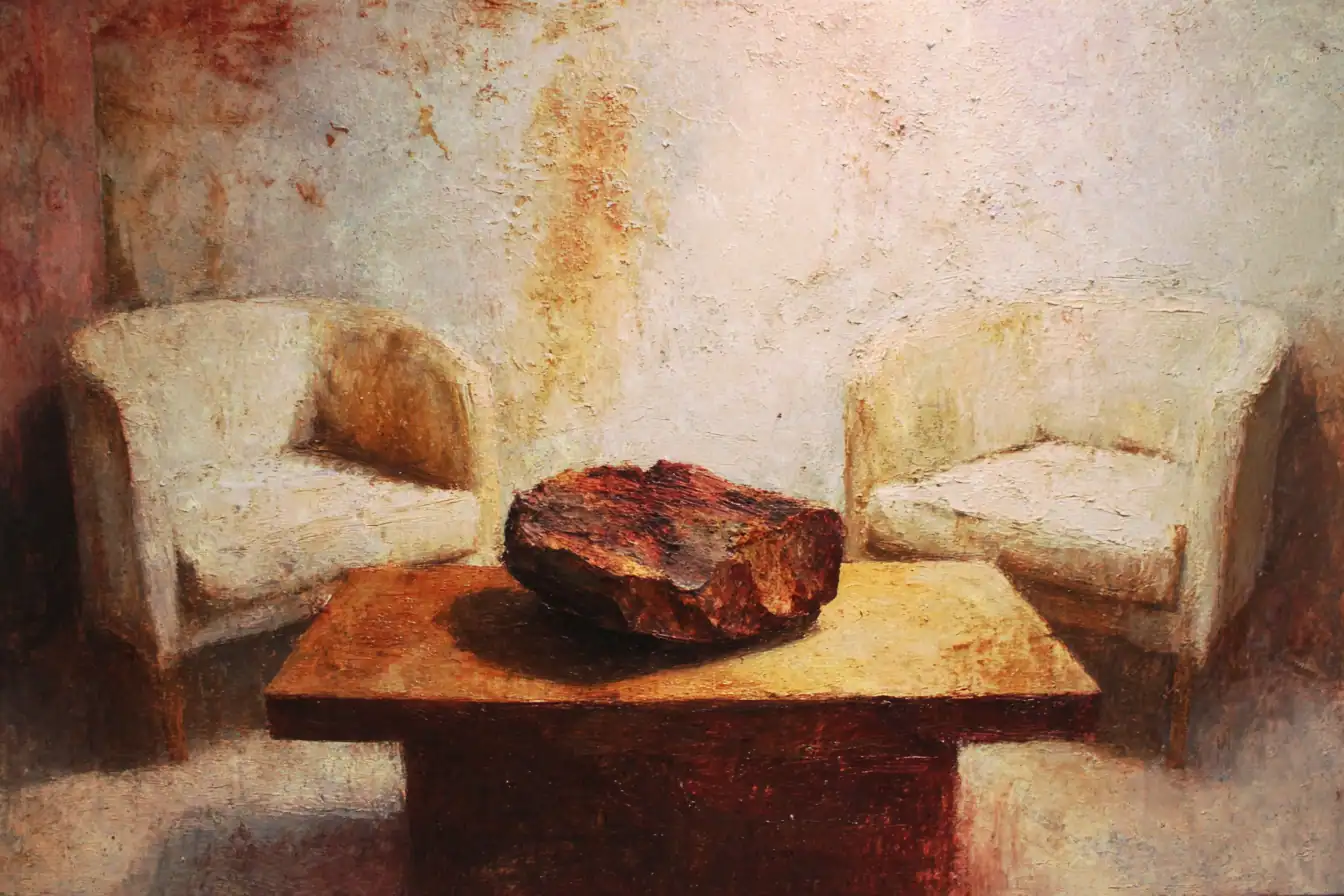
The tool is doing what the tool does.
That is the line between sensory tools for therapists and decor.
Decor sits pretty. Tools work.
Suppression forces the body to swallow what it cannot process. Containment gives the un-processable somewhere to live until the body is ready to integrate it.
Tangible Tools for Emotional Containment
Tangible tools for emotional containment externalize without erasing.
A stone like milky quartz offers steady opacity and cool weight; that makes it useful as a non-verbal processing tool in therapy. The client does not need to explain everything at once. The hand can register weight while the mouth catches up.
Rhodonite carries a different emotional signature. It suggests scar tissue that has closed enough to touch, and recognizes the part of the self learning how to stay present without turning into armor.
Catholic tradition has carried this knowledge for centuries in the rosary. A string of beads gives the hand a repetitive task while the mind metabolizes whatever it is sitting with. The beads keep the beat without anyone having to count. The fingers move, and the body follows. Beneath the religious frame, the somatic mechanism is familiar: rhythm, repetition, something to hold.
Catholic medals and prayer cards do related work. They make shame, fear, and grief small enough to carry in the hand instead of the gut.
Santería’s elekes offer a different kind of embodied containment through consecrated beads worn on the body, connecting the wearer to a larger relational and spiritual field. Otanes, the orisha stones, hold another kind of sacred responsibility: a place where suffering enters dialogue with something larger than the self.
The Afro-Diaspora mojo bag operates as a portable container, a small bundle that gives a person agency in the face of overwhelm. The Paquet Kongo extends that logic into an herb bundle that anchors allies and helps draw wounds out of the body’s private shadow.
These are living forms with lineages, initiations, rules, histories, and relationships.
You do not need to borrow them. In many cases, you absolutely should not.
What you can recognize is the shared logic underneath them: when the inside is too much, the outside has to help carry it.
Universal Functions of Symbolic Objects for Healing Spaces
Pull back far enough and the patterns become hard to miss.
Indigenous North American medicine bundles gather specific materials into a portable altar, holding belonging and protection in one place. A feather used to direct smoke gives the hand a way to clear residue and gives the breath a visible path. A rattle full of seeds or stones releases through vibration what cannot yet leave through speech.
Andean mesa stones, or kuyas, are understood to absorb and transmute what the practitioner cannot carry alone. Mesoamerican obsidian, in blade or mirror form, marks the hard edge of boundary and cord cutting. Curanderismo amulets for susto or mal de ojo give fright, overwhelm, and soul-disorientation somewhere concrete to go.
Pennsylvania Dutch himmelsbrief charms externalize a prayer for safety into something the hand can hold and the eye can see. Everyday charms made of bones, coins, and twigs have carried the old logic of transferring pain into an object that can bear it better than the body can.
Italian-American cornicelli deflect what the body would otherwise absorb, while the breve, a small red bag, reframes misfortune into something pocket-sized. Irish-American Brigid’s crosses mark the hearth as safe ground, and Irish blessing charms answer silencing and anxiety carried down through generations. Cowrie charms across the Afro-Diaspora link the wearer to ancestry and counter the isolation trauma loves to manufacture.
These practices are not interchangeable. They are not ingredients. They are not yours or mine to toss into some aesthetic stew and call it healing.
Treat them with more respect than that.
The Creator archetype belongs in this conversation because the Artist understands what trauma often forgets: form matters. Giving shape to the formless does not make pain disappear. It stops pain from being everywhere at once.
What these practices share is structural. The object is given a job. The body is relieved of carrying that job alone.
The functions repeat across cultures and centuries: tactile release, breath grounding, boundary marking, cord cutting, ancestral anchoring, wound externalization, agency restoration, relational safety, shame metabolization, pain cleansing, communal grief containment, memory processing.
That is not a buffet of borrowed rituals.
That is a map of what bodies under load have always needed.
Tactile Anchors and Threshold Clearing
Two functions deserve special attention in any room where trauma material moves through: tactile anchoring and threshold clearing.
A tactile anchor gives the nervous system a stable point of orientation through weight, temperature, and texture. Milky quartz held in the palm can offer exactly that. It has enough weight to register. It stays cool enough to track. Its opacity keeps the eye from falling into facets and sparkle. The hand closes around it, and the body has a fixed point.
Rhodonite carries a similar usefulness with a different emotional signature. It often sits well during integration work, when the harder material has already moved and what remains needs a quieter kind of holding.
Kyanite can carry the symbolic work of clean expression, the line between inner noise and spoken truth. Petrified Wood brings preserved memory into the hand: history held without panic. Citrine and Sunstone add brightness when the room needs a visual reminder that warmth has not gone extinct. Petoskey Stone, with its fossil pattern visible inside, makes memory processing feel less abstract: old life, held in pattern, still visible after pressure.
Across many Western and folk traditions, crystals and stones have been used in this broad way: weight, temperature, density, symbol. None of these stones does the therapeutic work for the client. Their value is simpler and more grounded. The body does not need a lecture. It needs something it can feel.
Threshold clearing does a different kind of work. It marks that one space has ended and another has begun.
Cedar and cypress have both been used across many traditions for this function. Their scent moves through a room and changes it. A practitioner who clears her space between sessions, in whatever way belongs to her lineage, ethics, and setting, is doing more than ritual performance. She is tending the nervous system of the room itself.
No client should have to walk into the residue of the last person’s hardest hour.
Both functions are old. Both are quietly clinical in the broadest sense of the word. Both give the body something to do besides brace.
Integrating Embodiment Practices for Trauma
The practitioners who last in this work tend to share one thing:
They have stopped making language do all the hauling.
Words are extraordinary tools. They are also limited. Some layers of trauma cannot be reached by talking because they were never stored in language. They were stored in posture, breath pattern, flinch, gaze, muscle tone, gut response, and the way the eyes track a room.
Embodiment practices for trauma meet that material where it lives.
Shadow work belongs here in its most practical form. Hidden pain gets heavier when it has no shape. Spiritual tools for somatic practice give that material a physical container before it becomes a sentence.
52 Weeks with the Dark is a structured practice for that work — fifty-two prompts written in the Shadow’s own voice, organized through the wheel of the year. It gives what lives in the dark a page, a season, and a shape. Find it here.
A stone passed between hands during a hard moment. A bell whose tone marks the close of a session. A bundle of dried herbs on a shelf that the client’s eyes always stop over. A piece of art on the wall holding an archetype.
These are not replacements for therapy. They are environmental conditions that make the body’s own intelligence more available to itself.
Pan-Western percussion traditions understood this through drums and bells: rhythm the heart could synchronize with, sound that gave grief somewhere communal to live. Indigenous rattles work through vibration and auditory containment, giving the body a discharge route that does not require explanation. Andean stone traditions understand weight and density as a way to ground, extract, and transmute suffering.
The transferable lesson is function.
You do not need to drum. You do not need to rattle. You need to recognize that the body has always known how to use object, sound, weight, and rhythm as part of its repair.
The room you work in can support that knowledge, or it can override it.
Choose carefully.
The Ethical Use of Spiritual Tools in Healing
Care matters most. Study function. Name the source. Do not steal the identity.
There is a difference between honoring the shared human logic of grounding objects and taking rituals from cultures that did not invite you in.
Humans have always made meaning with things: stones, beads, bowls, bells, cloth, dolls, wood, scent, image, weight. That impulse is old. That impulse is human.
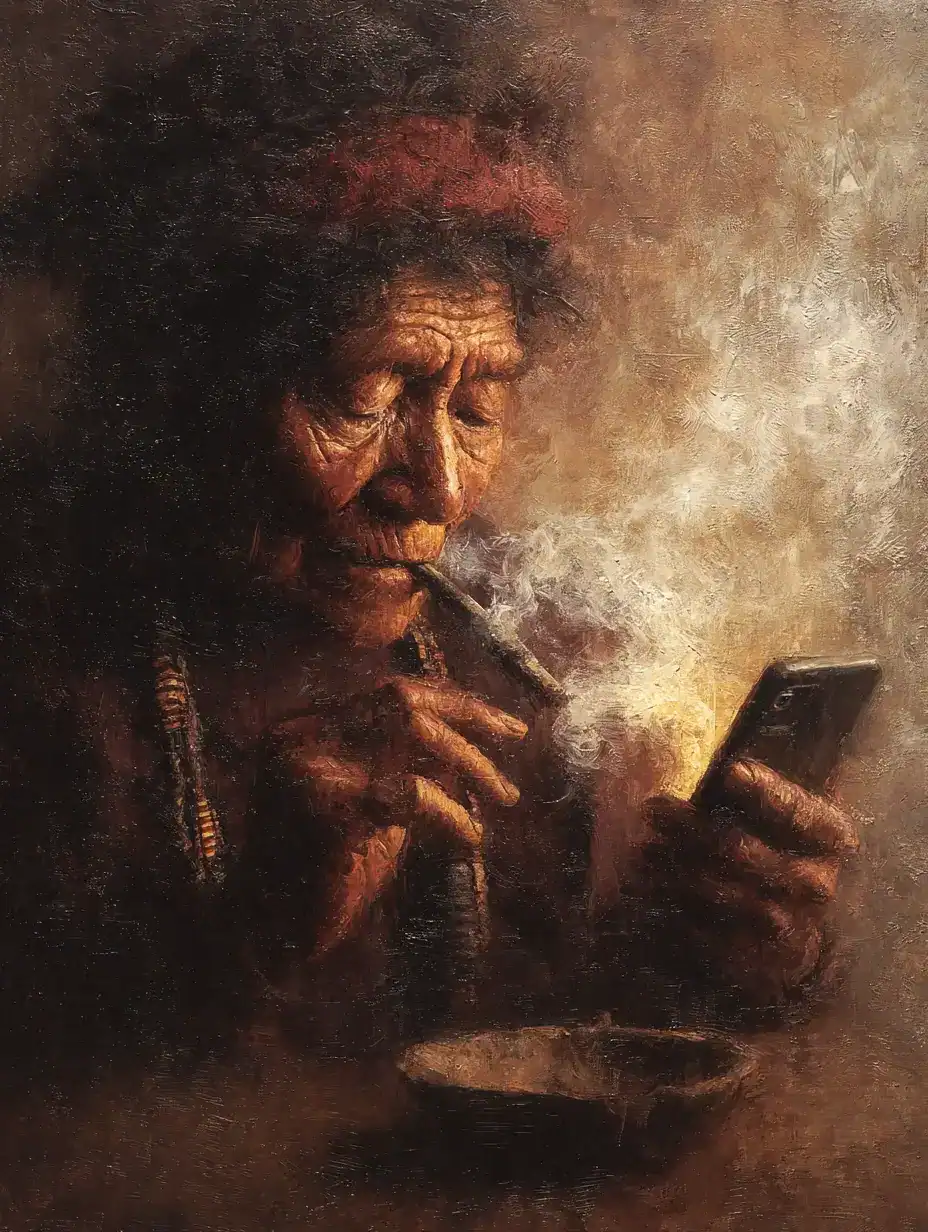
But specific ritual forms carry relationship. They belong to the people, places, lineages, and histories that shaped them.
So be honest.
If a practice comes from a culture, name it. If a teacher gave it to you, credit them. If you were not invited into a closed tradition, do not perform its rites, borrow its sacred objects, or invent a mystical family story to make yourself look authorized.
Influence is not the sin.
Erasure is.
Research. Credit. Ask what is yours to use, what is yours to admire, and what is not yours to touch.
What you can do freely and well is bring objects into your space that hold universal functions: weight, texture, rhythm, scent, image, memory, witness.
A stone from your own region. Wood from a tree you knew. A bowl made meaningful through use. A bell whose sound settles your body. A piece of art created with intention. A textile whose origin you can name.
The object does not need to be exotic.
It needs to be honest.
The Room You Build
The room you build is part of the work.
It cannot replace the relationship. It cannot replace clinical skill, ethical practice, consent, scope, or training. It can, however, reduce the amount of weight every nervous system in the room has to carry alone.
That is what balance looks like in this profession.
Not symmetry. Load distribution.
The mind carries what the mind can carry. The mouth carries what the mouth can carry. The object in the hand carries the rest until the body is ready to integrate.
Give the shelf, the stone, the scent, the image, and the weight real work to do.
Let the room become an accomplice in regulation.
Let the hand find something solid.
Let the unspeakable have a temporary address.
The nervous system has been waiting a long time for permission to put something down.
FAQ: Ethical Use of Spiritual Tools in Healing
Are grounding objects appropriate in a clinical or licensed therapy setting?
That depends on your scope, your licensure, your ethics code, and your institutional context.
Objects used as sensory or somatic supports, without therapeutic claims attached, can fit within many trauma-informed spaces. Objects framed as treatment, cure, diagnosis, or spiritual intervention are another matter entirely.
The distinction lives in the framing.
A stone can be a sensory anchor. A bowl can be a place to set something down. A piece of art can be a visual witness. Keep the language clean, the consent clear, and the claims out of fantasyland.
How do I introduce a grounding object to a client without making it weird?
Usually, you do less.
Place the bowl on the table. Let the stone sit on the shelf. Hang the image where it can be seen without demanding attention.
Clients who need the object will often find it. Clients who do not need it may never notice it.
Trauma-informed practice rarely benefits from over-explanation. It benefits from availability.
If a client asks about an object, answer simply. If a client reaches for an object, allow it within your boundaries and clinical judgment. Let the object stay ordinary enough to be safe and meaningful enough to matter.
How do I avoid cultural appropriation when choosing objects for my space?
Stay close to what is yours by relationship, region, training, lineage, or invitation.
If you have living ties to a tradition, work within those ties with respect. If you do not, choose materials whose function you understand and whose origin you can name without borrowing someone else’s sacred.
When in doubt, choose the object whose meaning you built through honest relationship over the object whose meaning you imported because it felt powerful.
52 Weeks with the Dark: Indelicate Prompts from Your Shadow
52 dark journaling prompts crafted in the haunting voice of your Shadow. A seasonal, printable guide designed to uncover what still hurts, haunts, and holds power.