Chapters
She woke up and knew something had been in the room.
Not a dream. Not quite. The weight was still there, pressing the memory of itself into her chest. She lay in the dark and took inventory of her own body the way you do after something happens to it. She did not say it out loud. She already knew how it would sound.
This piece will not tell her it wasn’t real.
The Intersection of Sleep Paralysis Trauma and Ancient Folklore
The oldest written records we have of human suffering include her.
Mesopotamian tablets, carved more than four thousand years ago, name a demon called Lilitu, a night-stalker who visited the sleeping. Medieval European accounts describe a creature of crushing weight that arrived in darkness and could not be refused. The Jinn, documented in pre-Islamic Arabian tradition and carried into European consciousness through Moorish Spain and medieval trade routes, were understood as capable of violation during sleep. West African cosmology holds its own testimony. South American folklore carries its own names for what comes in the night. Indigenous nations across this continent have always known that the dark is not empty.
These cultures had no contact with each other. No shared theology. No common language. They arrived at the same testimony independently, across millennia.
That is a historical record. This trauma is an ancient wound carried by ancient witnesses.
What they documented, the weight, the paralysis, the inability to call out, the sensation of being used by something that did not ask, has been reported so consistently, across so much of human history, that the word coincidence stops working entirely.
Something has been happening in the night for as long as people have been sleeping. And for as long as it has been happening, people have been trying to name it, warn each other, and survive the morning after.
Sleep paralysis trauma is not a modern discovery. It is an ancient wound with ancient witnesses.
The incubus arrives in the night. He has weight. He pins. He takes. The succubus does the same to male sleepers. The names change by culture. The entity does not. What remains consistent across every account is this: the visited one could not move. Could not speak. Could not refuse.
And almost without exception, the visited one was held suspect afterward.
Waking Up Feeling Physically Violated: Somatic Flashbacks During Sleep
Here is what the nervous system does with an experience it cannot process.
It keeps it.
Not as a narrative, not as a story with a beginning, middle, and end that you can take out and examine and put away. It keeps it as sensation. As the precise weight of a body that was not yours. As the specific cold of a floor, the specific grip of hands, the specific feeling of being held down and used while part of you watched from somewhere near the ceiling.
The body files it in the body. Not in language. Not in memory the way you remember a conversation or a year. In the marrow. In the muscles that braced. In the throat that could not make a sound.
Trauma researchers have a name for this: somatic flashback. The body memory replays without the context of time or place. There is no signal that says this is the past. The nervous system does not stamp its records with dates. When it replays, it replays in present tense. In sensation. In the specific, unmistakable physical experience of what was done.
If you have been sexually assaulted, you may wake in the night with the full-body sensation of it happening again. Not a dream with narrative logic. Sensation. Weight. Paralysis.
The freeze response, the same one that protected you when you could not fight, activates again, and you cannot move, cannot speak, cannot call out. Your body is replaying its most careful record of what happened to it, doing so with the fidelity of a wound that never fully closed.
Waking up feeling physically violated, with no waking-world event to attach it to, is one of the cruelest expressions of what sleep paralysis trauma can do. The body does not lie. It only speaks in a language the waking world refuses to translate.
The shame that arrives with the morning has nowhere to go. You cannot explain it without explaining something else first, something you may have never told anyone, something the people around you may not have believed when you tried. So you carry it back into the day. To work, to breakfast, to every ordinary hour of a life that looks intact from the outside.
You have learned not to say it out loud.
Somatic flashbacks during sleep are evidence of a functioning survival system. The body is doing exactly what it was built to do: preserve the record of what happened so that it can, someday, be witnessed. The body is waiting for a witness. It has been waiting for a long time.
The Incubus Folklore and Sleep Paralysis Connection
Sit with this for a moment.
A woman in fourteenth-century France and a woman in present-day Texas describe the same experience. The same weight. The same paralysis. The same inability to refuse. The same shame in the morning. The French woman names it an incubus. The Texas woman searches sleep paralysis trauma at three in the morning and finds clinical articles that tell her about REM atonia and hypnagogic hallucinations.
Both women experienced something. Both women are trying to name it with the vocabulary available to them.
Neuroscience simply put clinical language to an established pattern. The incubus folklore and sleep paralysis connection has always been a physical record. It is a pattern that humans have been living and recording for thousands of years. The neuroscience arrived later, offering its own language for the paralysis, the hallucinations, the sensation of presence, the inability to move or call out. That language is useful. It is not the whole story.
Because here is what the clinical language does not address: the woman who has never been assaulted, who wakes with the precise physical sensation of violation, who cannot explain it as memory because she has no such memory. The woman who feels something in the room that the clinical framework calls a hypnagogic hallucination and that every culture before the twentieth century called an entity with intent. The woman who is not replaying a trauma. The woman who is experiencing something that arrived from outside her.
Do not ask her to choose between those explanations.
The folklore does not ask her to choose. The folklore names what comes in the night, gives it weight and intention and a history, and says: this has happened before. You are not the first. You are not mad.
The spiritual meaning of waking up terrified is simple: something real entered your experience and your body recorded it faithfully. Whether that something is energetic or neurological or both simultaneously is a question this piece will not answer, because the answer is not the point.
The point is the testimony. The point is that she is believed.
Understanding Sleep Demons as Trauma and The Shadow
Every culture that named the incubus also, in some version of the telling, found a way to make the visited one responsible.
She must have invited it. She must have been spiritually unprotected. She must have done something, worn something, thought something, wanted something that opened the door. The medieval church said it plainly. Many traditions whispered it. That logic is ancient, and it is wrong, in exactly the same way that victim-blaming in assault cases is wrong. If something violated her, there must be something she did to deserve it.
That is not theology. That is the same logic that follows every rape report into every courtroom.
The Shadow, in Jungian understanding, holds what we cannot face in the light. It carries the repressed, the refused, the unspeakable. It lives in the dark because we put it there. And it does not go away simply because we refuse to look.
Understanding sleep demons as trauma means understanding that the Shadow is not the enemy. The sleep demon, whether you experience it as an entity with weight and intent or as your own nervous system replaying its most terrible record, is presenting something that demands to be witnessed. The Shadow holds the truth the waking world refused to hold. It brings the testimony back, night after night, because the testimony has not yet been received.
The freeze response that makes you unable to move during sleep paralysis trauma is the same freeze response that protected you when you could not fight. The Shadow is not attacking you. The Shadow is holding what you survived. It is presenting the unedited record and asking: are you ready to look at this now? Is there finally someone who will sit with this?
The sleep demon meaning is not punishment. It is not weakness. It is not invitation.
It is the oldest form of testimony there is. A body that remembers, and a darkness that refuses to let the memory dissolve until it is finally, fully witnessed.
Tools for the Unbreakable Container: Stones for Sleep Paralysis Grounding
She does not need to be fixed. She needs something that can hold weight without flinching.

That is what grounding tools are for. Not to cure. Not to banish. Not to promise that the night will be different. But to give her something heavy and steady and real to hold onto when the morning arrives with its particular kind of devastation.
Montana Moss Agate is the stone for this work. It does not rush. It does not demand resolution. Its energy is the unbreakable inner container: steady, non-fixing, capable of sitting with difficult emotions the way a good witness sits: present, solid, refusing to look away. When the morning is hard and the body is still holding what the night brought, Montana Moss Agate is the weight that says I am here. You do not have to make sense of this right now.
Place it in your hand. Let it be heavy. That is enough.
Smoky Quartz is the stone that absorbs what she cannot carry. Fear of the dark. The dread of sleep. The anticipatory grief of knowing the night will come again. Smoky Quartz does not ask her to process those things. It acts as an energetic vacuum, drawing the weight of the fear into itself so her body does not have to hold all of it alone. Set it on the nightstand. Let it do its work.
Rhodonite brings fierce compassion to the emotional scarring. It does not minimize what happened. It does not hurry the wounds toward closing. Rhodonite applies steady, uncompromising care to the places that still ache, the torn and unfinished places the violation left behind, whether that violation was energetic, neurological, or both. It is not a gentle stone. It is a determined one. It knows what it is doing.
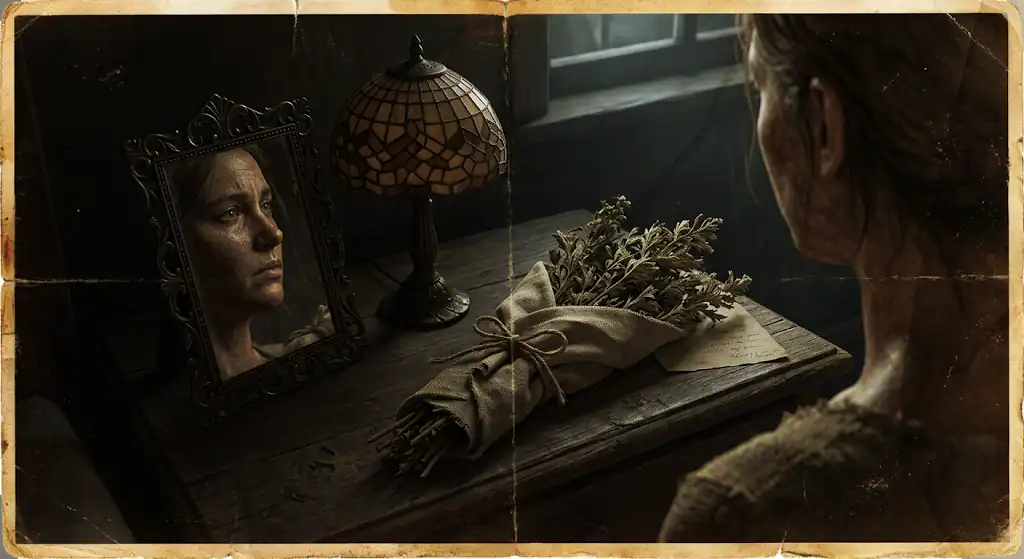
Mugwort has been used for centuries as a guardian of the threshold between waking and sleep. It honors the dream realm and the sleeping body. It does not promise protection so much as it marks the boundary: this body is sacred ground. Mugwort has long been used in women’s traditions, in dreamwork, in the honoring of the psychic threshold where the night begins. Burn it as incense before sleep, or place dried mugwort in a small cloth near the bed.
A note on mugwort: It carries significant risks for those who are pregnant, breastfeeding, or managing certain health conditions. Do not use it internally. Consult a knowledgeable practitioner before use if you have any health concerns.
Blue Tansy calms the mind that cannot stop replaying. It supports the kind of clear, steady communication that allows the Seeker to finally name what she experienced, even if only to herself. Its energy settles the nervous system at the throat, cooling the place where words get stuck, clearing the channel between what the body knows and what the mind can finally say aloud.
These are not cures. They are companions. Stones for sleep paralysis grounding work the way a steady hand works: not by solving the problem, but by making sure she does not face it entirely alone.
The Integration Act
Write this phrase on a piece of paper: My body’s testimony is real.
Place a heavy stone over it. Montana Moss Agate, if you have it. A river rock, if you don’t. Something with weight. Something that does not move easily.
Leave it there.
You do not need to do anything else with it. You do not need to analyze it or explain it or decide what it means. The stone holds the truth of the statement. The weight is the witness. The paper underneath is the testimony that has been waiting for someone to believe it.
That someone is you.
If writing is how you witness it, 52 Weeks with the Dark was made for this. The Shadow speaks directly to you and the prompts don’t look away from what the night holds. It’s here when you’re ready.
Protective Art for Trauma Survivors: Holding the Witness
Art that carries weight is different from art that decorates.
A piece of art that was made to hold what cannot be spoken does not ask you to explain yourself. It does not require that you have your story straight or your healing complete or your understanding of what happened fully formed. It sits in the room with you the way a good witness sits: steady, present, making no demands.
Kellie Jo Art’s guardian-style dolls and symbolic art objects are made for this space. The space between knowing and being free of the impact. The space where you are still integrating. Still living after knowing. Still holding what remains while something like strength forms itself in the dark, slowly, without announcement.
These are not therapeutic tools. They are not replacements for the work of healing, which is its own long and unglamorous process. They are companions. Physical anchors in the room where the night happens. Objects that carry the energy of witness: I see what you are carrying. I am not looking away.
Night guardian dolls for adults exist in a tradition as old as the incubus itself. Protective figures, carved or sewn or shaped, placed at the threshold between the sleeping body and whatever the dark brings. They are not magic in the sense of guaranteed outcome. They are intention made physical. They are the act of a woman deciding that her sleeping body deserves a guardian, that the night deserves to be marked as sacred ground, that she is worth protecting even when she cannot protect herself.
The Caregiver energy in Kellie Jo’s work is fierce. It does not offer comfort that costs nothing. It offers the kind of steadiness that has looked at hard things and stayed anyway. The art objects in the shop collection carry that energy: unflinching, compassionate, made for women who have stopped expecting the world to be gentle and started building something sturdier.
Protective art for trauma survivors is not about closure. It is not about the moment when everything is finally okay. It is about the long middle: the months and years of waking up, taking inventory, carrying the testimony forward into another day. It is about having something in the room that was made with full knowledge of what the night can hold, and chose to stay anyway.
Frequently Asked Questions
Is sleep paralysis trauma different from regular sleep paralysis?
Sleep paralysis itself is a known neurological event: the body remains in the muscular stillness of REM sleep while the mind begins to wake. For many people, it is brief and unremarkable. Sleep paralysis trauma describes what happens when that state carries the weight of prior violation, when the body’s inability to move activates the same freeze response that was present during an assault, when the paralysis itself becomes a somatic flashback, when the morning after carries shame and devastation that cannot be explained by the clinical definition of a sleep event. The neurological framework describes the mechanism. It does not describe what it is like to live inside it.
Can the incubus and succubus be real and be a somatic flashback at the same time?
Yes. This piece holds both realities without collapsing either one. The incubus and succubus are among the oldest documented entities in human history, reported across cultures with no contact with each other, consistently described with the same characteristics: weight, paralysis, violation, the inability to refuse. That is testimony. Modern trauma neurobiology documents how the body replays violation with complete physical fidelity during sleep, in present tense, without the context of time. Those two realities are not mutually exclusive. The body’s memory and the ancient entities of the night may be speaking the same language. You do not have to choose between them.
Why do I feel ashamed after a sleep paralysis episode that involved violation?
Because almost every cultural tradition that named the incubus also found a way to make the visited one responsible for the visit. She was spiritually unprotected. She invited it. She wanted it. That logic is ancient, and it is wrong, in exactly the same way that victim-blaming in assault cases is wrong. The shame does not belong to you. It was placed there by a very old and very persistent habit of holding the violated one accountable for the violation. The shame is not evidence of guilt. It is evidence of how long this particular lie has been told.

She is not the first.
Thousands of years of human testimony say so. Women in every culture, in every century, in every language available to them, have tried to name what came for them in the night. They named it incubus. They named it Jinn. They named it the old hag, the night-stalker, the mare, the demon lover. They named it because naming is the first act of witness. Because a thing that has a name can be spoken of. Because a body that has been violated deserves to have its experience acknowledged in language, whatever language is available.
She named it something too. Maybe she searched for it at three in the morning. Maybe she is reading this now with the particular recognition of a woman who has never seen her experience written down before and is feeling the strange vertigo of being seen.
The night is not empty. The body does not lie. The testimony is real.
There is no resolution to offer here. No promise that the nights will be easier or the mornings less heavy. Only this: the truth is written. The incubus is named. The body remembers what happened. The shame is recognized and placed where it belongs, which is not with her.
The materials discussed in this piece, Montana Moss Agate, Smoky Quartz, Rhodonite, Mugwort, and Blue Tansy, are offered as symbolic and energetic companions, not as medical treatments or clinical interventions. Mugwort carries significant health risks and should not be used internally. Avoid mugwort entirely if you are pregnant, breastfeeding, or managing organ-related health conditions. Rhodonite in rough form may leave mineral powder on the hands; wash after handling.
This piece does not constitute therapy, diagnosis, or medical advice. If you are experiencing trauma responses, please consider working with a trauma-informed therapist.